
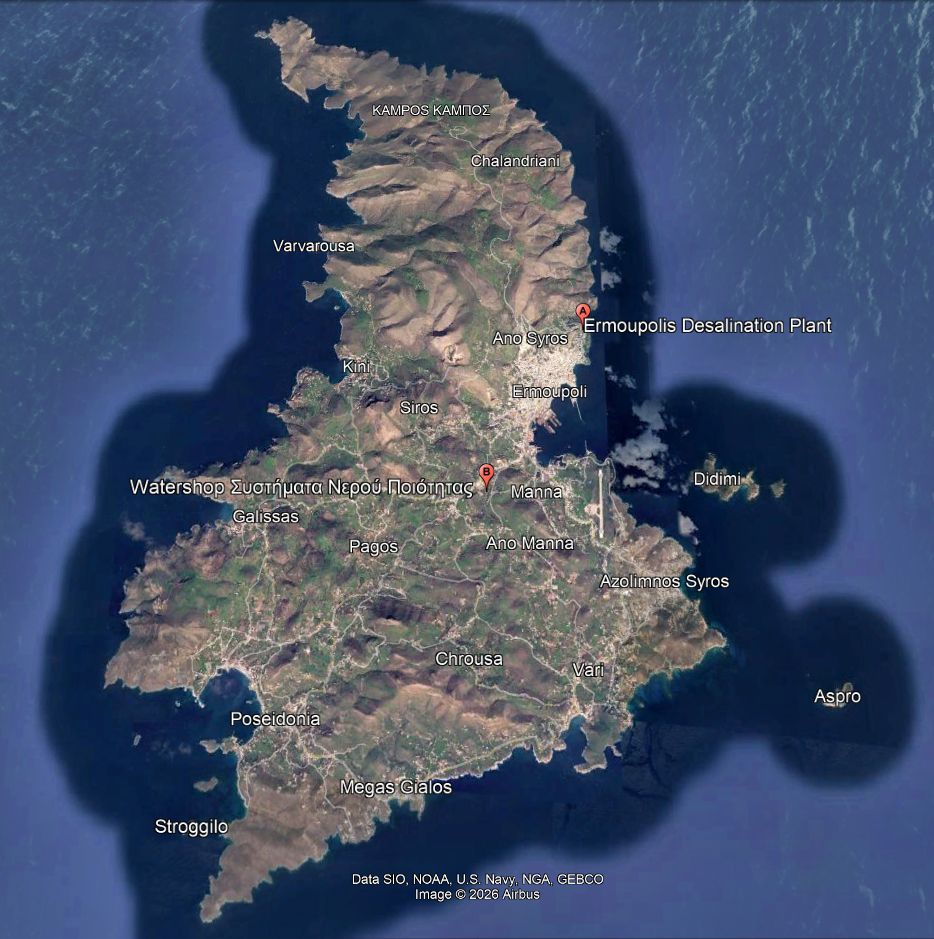
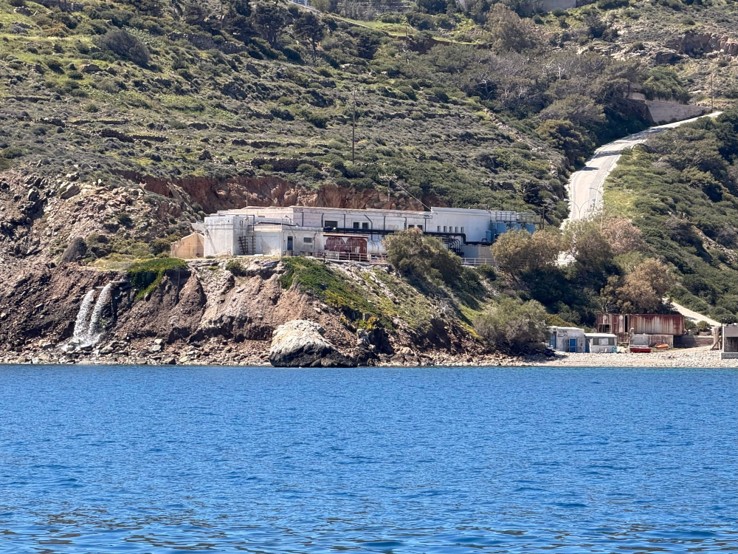
Syros Desalination Plant
Source: https://www.namanet.gr/projects/ermoupolis-desalination-plant
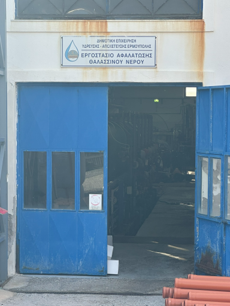
Desalination Plant Entrance
Description
Syros is a Greek island in the Cyclades (Aegean Sea) with an area of 83.6 km2 and a population of 21,124 people (2021 census). The island's drinking water supply network, sewer system and wastewater treatment plants (WWTPs) are managed by the Municipal Water Supply and Sewerage Company of Syros (DEYAS). The drinking water supply network largely relies on reverse osmosis seawater desalination plants, with a total supply of 1.7-2.2 hm3/year (including the network losses), while groundwater can also contribute to a much lesser extent. For 2023, the desalination plants and the groundwater abstractions accounted for 96% and 4%, respectively, of the water supplied by DEYAS (data by DEYAS). The irrigation demands, on the other hand, are largely covered via groundwater abstractions. Currently, a relatively small quantity of wastewater that undergoes tertiary treatment is used for Managed Aquifer Recharge (MAR) and irrigation while interventions related to AWR are being examined. Those are extension of wastewater reuse for MAR and irrigation and extension of Rainwater Harvesting (RWH) installations on the island to alleviate the pressure on the other water sources. Additionally, increase of desalination capacity is also considered and examined. Similar to other Greek islands, harvesting rainwater is not a new practice for Syros. Rainwater cisterns have been traditionally used in the island, and some are still in use today.
For the purpose of RECREATE project, a systemic modelling approach that integrates different tools to assess baseline and AWR implementation under climate change uncertainty and different socio-economic scenarios while taking into account water – energy interactions, combinations of technologies, pricing mechanisms, seasonal demand options and water-related behaviours is being deployed. This is achieved by exploiting the model capabilities of the Urban Water Optioneering Tool (UWOT), the System Dynamics and the Agent-Based Modelling. Utilising the above tools, RECREATE approach applied in Syros starts from SSPs to regional evolution and eventually to system perform. AWR interventions’ assessment and planning is supported by a stress-testing framework and a state-of-the-art adaptation pathways module (including genetic algorithm optimization approaches but also Reinforcement Learning).
MAR activities are also implemented in the island with significant impact to stakeholders, especially the farmers. Community of Practice activities implemented and planned in the island support the acceptance of AWR and their upscale and transferability potential.
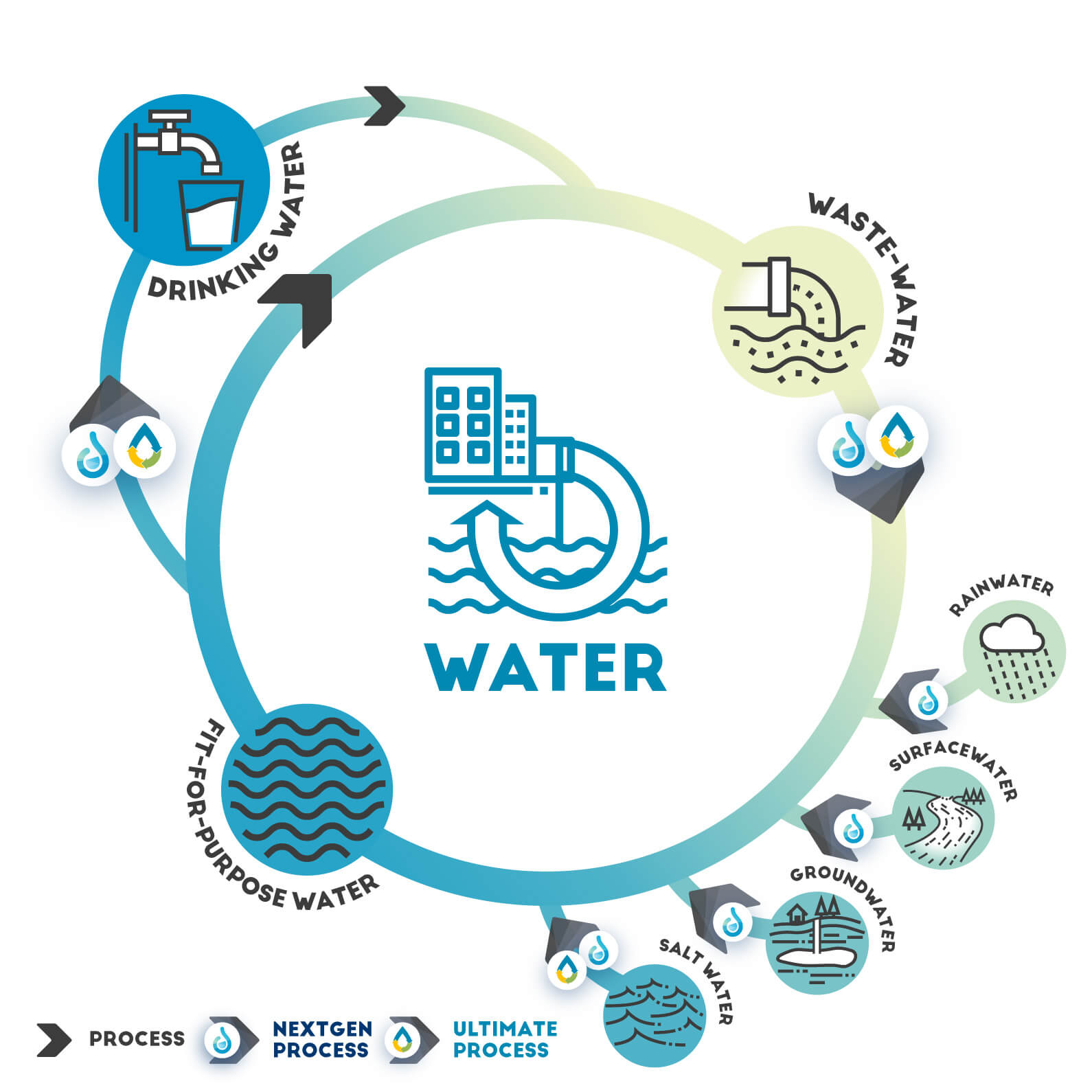
Applied technologies
Technology performance and best practices
Current desalination capacity seems to be limited under future scenarios. Expansions may ensure future proofing but not without possible additional cost due to energy crisis. Additional AWR, including rainwater harvesting, a traditional practice in the wider Cycladic island complex, can partially mitigate the high-cost issue. Nevertheless, rainfall patterns and uncertainty related to rainfall, as well as their implementation upscale, are of major influence with respect to rainwater harvesting system’s efficiency (e.g. the system’s contribution in summer is limited). Detailed modelling results will be provided at a later step when respective deliverables will have been submitted (e.g., D1.4, D4.3)
Outcome of assessments
Current modelling chain is under development. Nevertheless, preliminary assessments indicate an expected high rise of tourism (both inbound and domestic) in the following years, coupled with an expected expansion of luxurious tourism and related infrastructures (e.g., marinas and pools). This intensifies stresses to Syros’ system leading to the need for additional interventions from the AWR spectrum including but not limited to expansion of desalination plan, rainwater harvesting at domestic level, artificial recharge of groundwater using water that has undergone tertiary treatment, as well as potential policy interventions such as mandatory use of seawater for pools. Additional assessments and details will be available after the modelling chain and its application is finalized.
Legislation and policy recommendations
- Maffettone R., Gawlik B.M., Technical Guidance - Water Reuse Risk Management for Agricultural Irrigation Schemes in Europe, Publications Office of the European Union, Luxembourg, 2022, doi:10.2760/590804, JRC129596.
- EU Legislation for Water reuse: (EU) 2020/741
- Greek Legislation for Water reuse: ΚΥΑ 145116/2011
- Greek Legislation 5170/2025 (ΦΕΚ Α' 6/20.01.2025) foresees optional use of sea water for pools.
Applied product
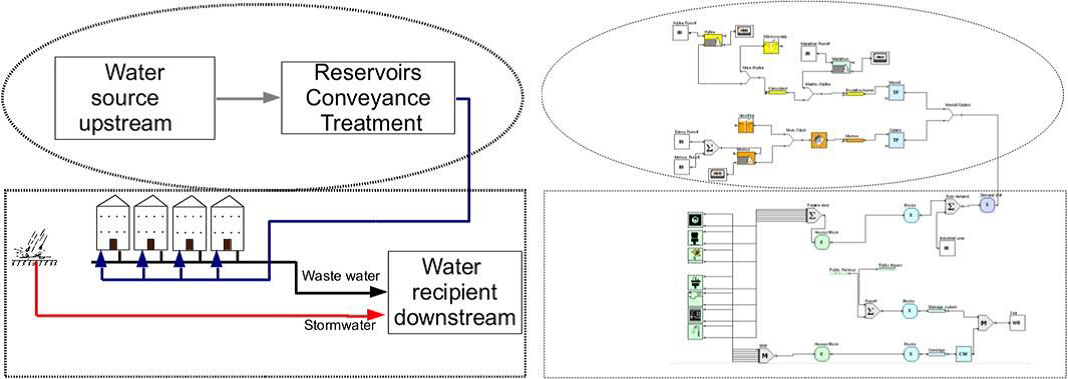
Urban Water Optioneering Tool
UWOT is a decision-support tool that allows users to compare different water management technologies (including water s…