Description
SUOSIL – Advanced Sludge Treatment and Valorisation Technology
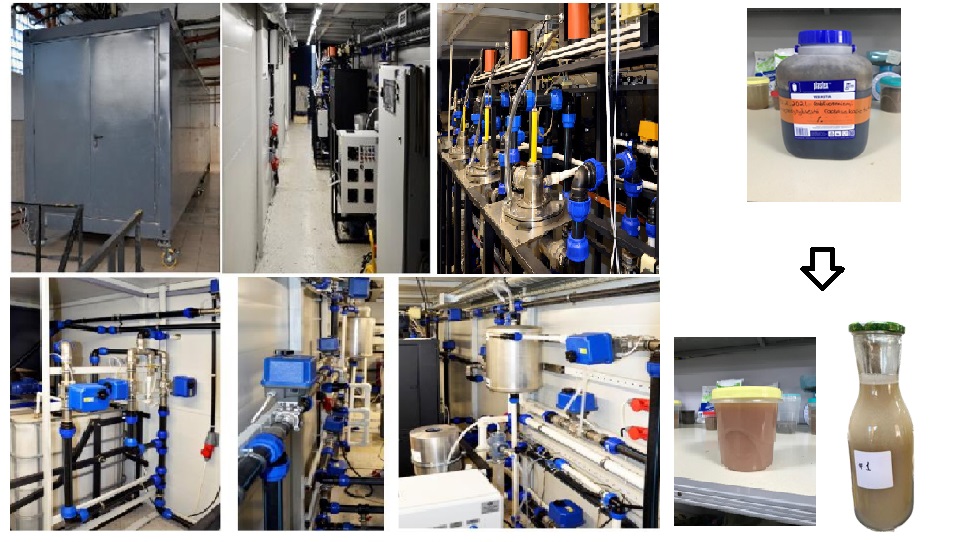
SUOSIL is a modular and scalable industrial technology for the advanced treatment and valorisation of sludge generated in wastewater treatment plants. The system transforms residual sludge into a stabilised and hygienically safe liquid organo-mineral product, enabling water reuse, nutrient recovery, and the reduction of environmental and regulatory risks, without generating secondary waste streams.
The technology is designed for continuous operation and processes between 1 and 3 m³ of sludge per hour, making it suitable both for pilot installations and for scalable deployment in municipal and industrial wastewater treatment plants.
SUOSIL operates through three main technological stages, sequential and complementary, which act directly within the sludge matrix.
In the first stage, electro-hydraulic treatment based on the Yutkin effect is applied through high-voltage pulsed electrical discharges in a conductive liquid medium. These discharges generate localised ultra-high pressures, shock waves, cavitation phenomena and intense micro-turbulence. As a result, sludge flocs are disintegrated, microbial cell membranes are ruptured, and organic and inorganic structures are mechanically fragmented, while the material is simultaneously homogenised. This stage provides a strong bactericidal effect without the need to add chemical disinfectants and prepares the sludge for the subsequent stages of the process.
In the second stage, ultrasonic cavitation (sonolysis) is applied using a continuous-flow ultrasonic disperser. Alternating high- and low-pressure acoustic waves generate cavitation bubbles that collapse violently, producing very high hydrodynamic shear forces. This process intensifies the destruction of cellular structures, fragments long molecular chains, releases intracellular material and improves the availability of nutrients bound to organic matter. In addition, sonolysis contributes to the oxidative transformation of toxic organic compounds, such as pharmaceuticals, endocrine disruptors and antibiotic residues, reducing their biological activity and environmental risk.
In the third stage, controlled ozonation combined with cavitation is applied. Ozone is introduced directly into the treated sludge. As a powerful oxidising agent, ozone enables rapid and broad-spectrum inactivation of microorganisms, including bacteria, viruses, spores, cysts and parasites, as well as oxidation of remaining organic and inorganic contaminants. Ozonation also removes odours and contributes to stabilisation of the final product. Residual ozone decomposes rapidly into oxygen, without generating toxic by-products.
The combined effect of these three main stages results in deep disinfection and effective stabilisation of the sludge. Analytical results and laboratory studies demonstrate a reduction of Escherichia coli to ≤ 1 CFU/g, corresponding to a removal efficiency greater than 99%. A significant reduction of enterococci is also observed throughout the process, decreasing from 51.4% in raw sludge to 16.2% in the treated product. No pathogenic bacteria, clostridial spores, cysts, eggs or parasite larvae are detected in the final product. The treated material reaches Class A sanitary quality, consistent with European requirements for controlled agricultural reuse.
Regarding inorganic contaminants, SUOSIL does not concentrate or remove heavy metals through separation processes. Instead, it promotes their stabilisation within the organo-mineral matrix, reducing their mobility and bioavailability. The results show consistent reductions across the treatment stages, reaching up to a tenfold decrease in the bioavailable fraction of heavy metals such as Zn, Cu, Ni, Pb and Cd. Final concentrations are well below the limits established by applicable European regulations for treated organic products.
The system operates with an average energy demand of approximately 100 kWh per tonne of treated sludge, which is significantly lower than that of conventional technologies such as thermal drying or incineration. The core process does not require the use of persistent chemical reagents and is designed for automated operation with low staffing requirements.
SUOSIL is applicable to municipal and industrial wastewater treatment plants facing increasing sludge management costs, regulatory restrictions on incineration and landfilling, and the need to implement circular economy and water reuse strategies. Its modular and containerised design allows direct integration into existing infrastructure and facilitates its use in pilot, demonstration and full-scale deployment projects.
The innovation introduced by SUOSIL lies in its whole-matrix sludge treatment approach and in the integration of electro-hydraulic shock, ultrasonic cavitation and ozonation into a single continuous process line. Instead of treating sludge as a waste stream to be minimised or eliminated, SUOSIL transforms it into a stabilised and reusable resource. By eliminating secondary waste streams and preserving water and nutrients, the technology enables wastewater treatment plants to evolve from end-of-pipe facilities into true resource recovery hubs.
Owner of the product
Sign in to access this information.Actors, their roles and interactions
The actors involved include municipal and industrial wastewater treatment plant operators, technology providers, engineering and manufacturing companies, regulatory authorities, and end-users in agriculture, greenhouse production and land management.
Wastewater utilities and treatment plant operators deploy and operate the SUOSIL system within existing treatment facilities, enabling the on-site treatment and valorisation of sewage sludge. This approach avoids off-site transport, landfilling, incineration and other energy-intensive end-of-pipe solutions, reducing operational costs, regulatory risks and associated carbon emissions while ensuring compliance with sludge management and water reuse requirements.
Technology providers are responsible for the design, system integration and performance optimisation of the SUOSIL technology. In cooperation with local engineering and manufacturing companies, they enable the fabrication, assembly and customisation of modular SUOSIL units. This distributed manufacturing model supports localisation of production, development of regional industrial supply chains and creation of skilled jobs in engineering, fabrication, installation and technical maintenance.
Engineering, EPC and industrial manufacturing companies play a key role in producing and integrating modular SUOSIL units into existing wastewater treatment infrastructure, adapting the systems to site-specific technical and regulatory conditions. Their involvement contributes to regional economic development, workforce upskilling and the strengthening of local industrial ecosystems related to water, environmental and circular economy technologies.
Regulatory and supervisory authorities oversee compliance with environmental, sanitary and water reuse regulations, ensuring that treatment processes and recovered products meet applicable safety and sustainability standards. This regulatory oversight provides legal certainty for utilities, technology providers and end-users, supporting long-term and large-scale deployment.
End-users of the recovered resources include agricultural enterprises, greenhouse facilities, agroforestry projects, land reclamation initiatives and other land-use applications requiring reliable access to water and nutrients. Reclaimed water can be used for irrigation, including in controlled agricultural and greenhouse systems, while the stabilised organo-mineral product can be applied for soil conditioning, nutrient replenishment and land restoration, in accordance with local regulatory frameworks.
The interaction between these actors creates an integrated value chain in which wastewater treatment plants evolve from conventional sludge disposal facilities into circular, low-carbon and resource recovery-oriented hubs. This ecosystem-based approach maximises the reuse of water and nutrients, avoids the generation of secondary waste streams, minimises environmental impacts and enables the practical implementation of circular economy and water resilience strategies.
Unique selling points
- Full treatment of the entire sludge matrix without fractionation and without generating secondary waste streams
- 100% recovery of water for reuse, in contrast to conventional technologies where water is lost as filtrate, liquid rejects, ash-related losses or residual effluents
- Resource recovery-oriented process enabling the simultaneous reuse of water and nutrients
- Fundamentally low-carbon alternative to thermal drying, incineration and landfilling of sludge
- No generation of ash, digestate, liquid rejects, concentrates or hazardous by-products
- Integrated hygienisation achieving Class A sanitary quality, compliant with EU requirements for controlled reuse
- Effective pathogen reduction without the use of persistent chemical disinfectants
- Comprehensive inactivation of bacteria, viruses, spores, cysts and parasites
- Stabilisation of heavy metals within the organo-mineral matrix, significantly reducing their mobility and bioavailability
- No concentration of contaminants and no need for subsequent disposal or treatment of residual fractions
- Preservation and valorisation of nutrients, enabling agricultural use, soil conditioning and land reclamation applications
- Single continuous process integrating electro-hydraulic treatment, ultrasonic cavitation and ozonation
- Direct treatment of fresh sludge on-site at wastewater treatment plants, without prior dewatering, digestion or thermal processing
- Modular, containerised and scalable system with a capacity of 1–3 m³/h
- Suitable for phased deployment, from pilot installations to full-scale industrial roll-out
- Minimisation of sludge transport and associated CO₂ emissions and logistics costs
- Predictable operation and seamless integration into existing wastewater treatment infrastructure
- Lower capital expenditure per unit of treatment capacity compared to conventional sludge treatment technologies, enabled by modular design, simplified process architecture and the absence of large-scale thermal or separation equipment
- No dependency on end-product markets: the technology addresses a mandatory sludge management obligation, rather than relying on product sales
- Supports the transition of wastewater treatment plants from end-of-pipe facilities to circular water and resource recovery hubs
- Aligned with EU strategies on water reuse, circular economy and water resilience
Technical requirements
Technical requirements to obtain, install or run the tool, product or service.
The deployment and operation of the SUOSIL system require standard technical conditions commonly available at municipal and industrial wastewater treatment plants. No specialised or uncommon infrastructure is needed beyond typical sludge handling and utility connections.
The key technical requirements include:
- Availability of fresh sewage sludge at the wastewater treatment plant, with direct hydraulic connection from existing sludge handling lines
- Sufficient space for the installation of modular, containerised SUOSIL units, either outdoors or within existing technical areas of the facility
- Standard electrical power supply suitable for industrial equipment, without the need for high-temperature or high-pressure systems
- Access to process water and basic utility connections required for system operation and cleaning
- Integration with existing plant control systems (SCADA or equivalent) for monitoring, automation and data logging
- Ventilation and safety arrangements in accordance with standard industrial and occupational safety regulations
- No requirement for pre-dewatering, anaerobic digestion, thermal drying or chemical conditioning of the sludge prior to treatment
- Minimal use of consumables, with no reliance on persistent chemical reagents
- Basic technical personnel for routine operation and supervision, supported by automated process control
- Compliance with local environmental, sanitary and water reuse regulations for treated water and organo-mineral products
The modular design of SUOSIL enables phased installation, rapid commissioning and straightforward integration into existing wastewater treatment infrastructure. The system is designed for continuous operation with low maintenance requirements and can be adapted to site-specific technical and regulatory conditions.
Publications
The SUOSIL technology is based on well-established physical and chemical principles, including electrohydraulic treatment, ultrasonic cavitation, and ozonation, which have been widely described and validated in the scientific and technical literature related to wastewater and sludge treatment.
At the current stage, the development of SUOSIL has primarily focused on technological integration, system engineering, pilot-scale validation, and intellectual property protection. As a result, the main documented outputs consist of technical reports, laboratory and pilot test results, and patent applications, rather than academic publications.
The core elements of the SUOSIL technology are protected by granted and pending patents, which complement the existing scientific literature and support the technological novelty and originality of the solution.
Scientific publications related to the underlying treatment mechanisms (electrohydraulic shock effects, sonolysis, and advanced oxidation processes) are widely available in the fields of environmental engineering, wastewater treatment, and resource recovery, providing a solid scientific basis for the SUOSIL process.
Peer-reviewed publications and additional technical dissemination activities are foreseen within ongoing and future pilot and demonstration projects, in cooperation with research institutions and wastewater treatment plant operators, in order to document system performance, environmental benefits, and reuse outcomes.
URL
https://suosil.com/videoeng.webm
Technologies applied by the product
Wastewater Treatment and Sludge Valorization
Wastewater treatment technologies for water reuse
Wastewater treatment and water reuse by implementing circular economy principles is an alternative source of water supp…