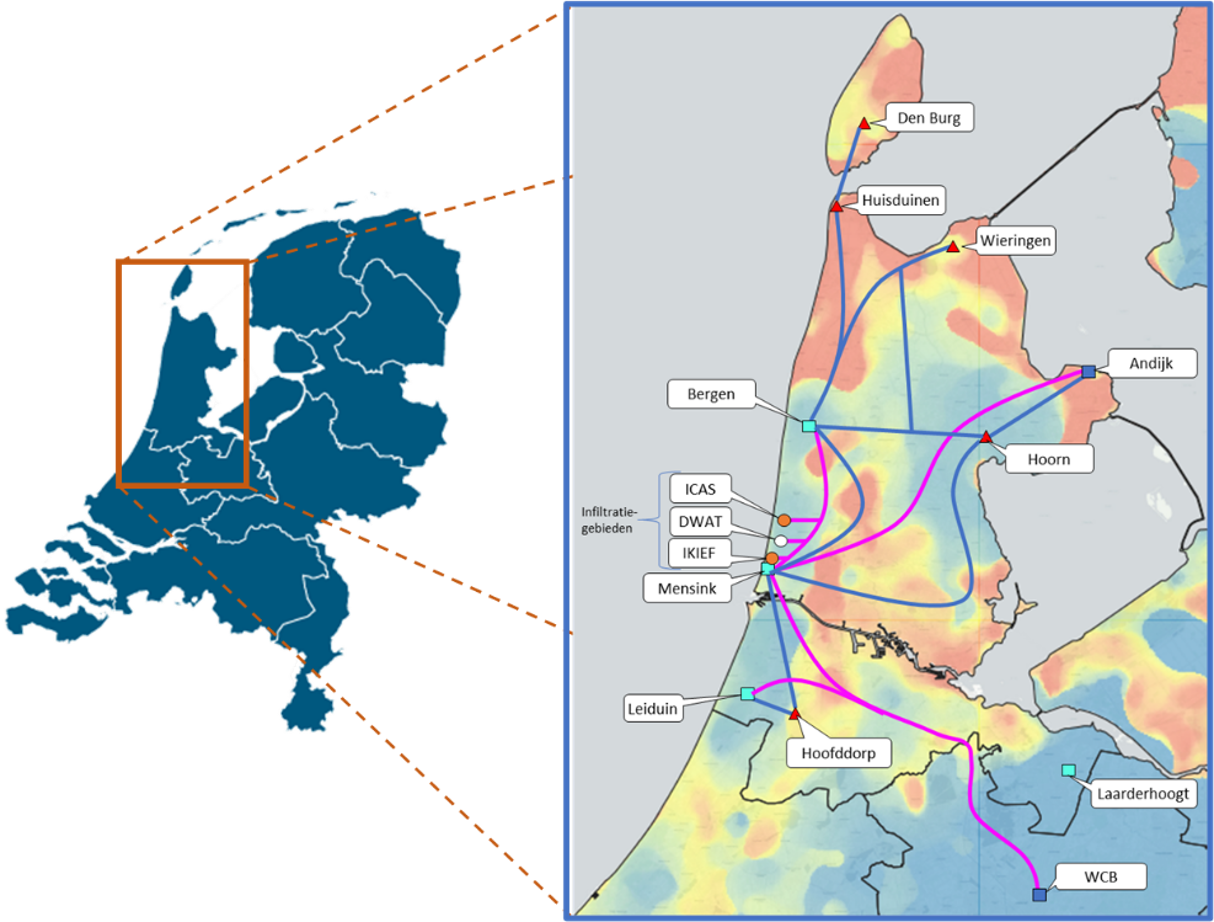
Overview of PWN drinking water system
Source: PWN
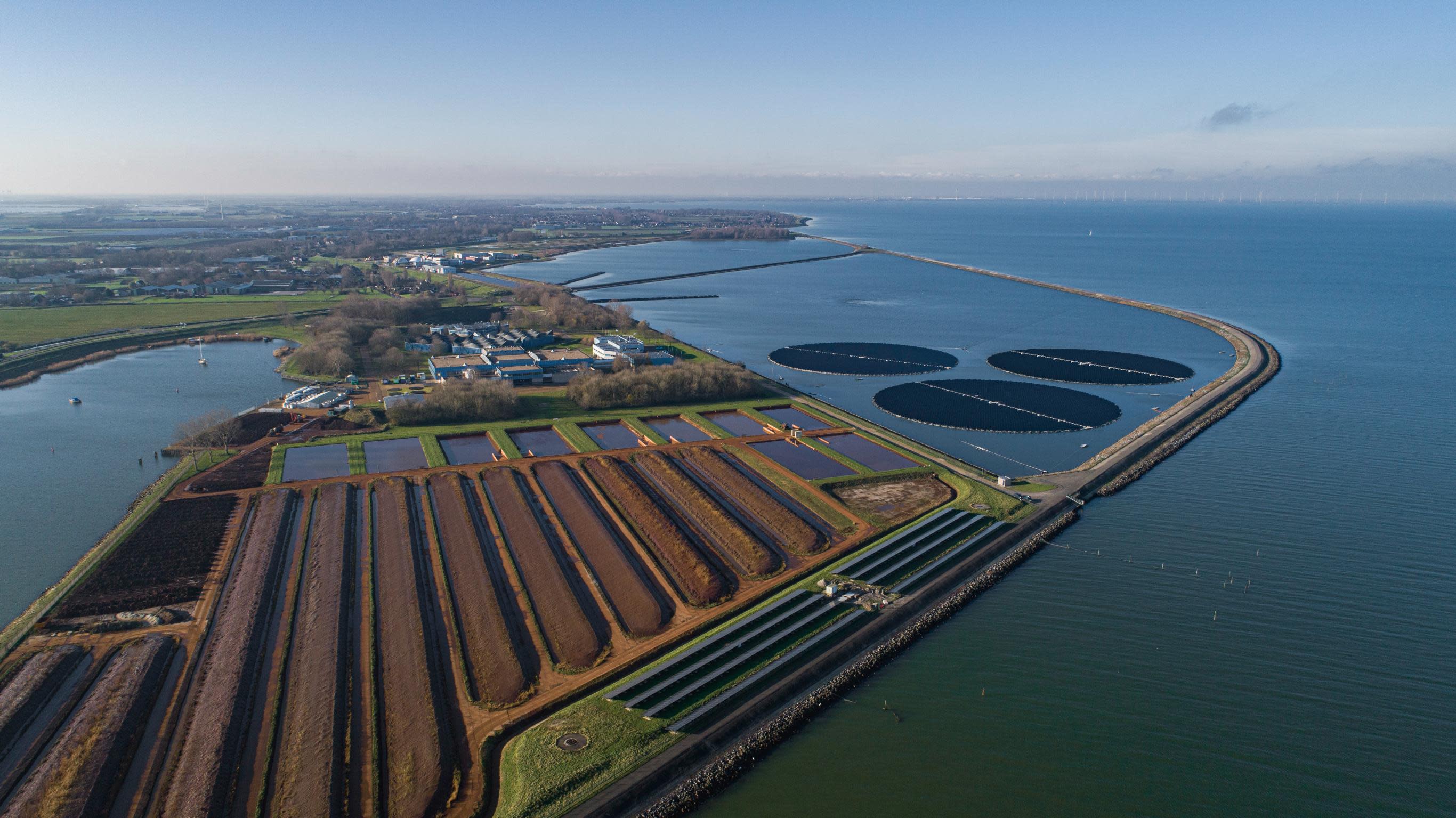
Andijk surface water reservoirs
Source: PWN
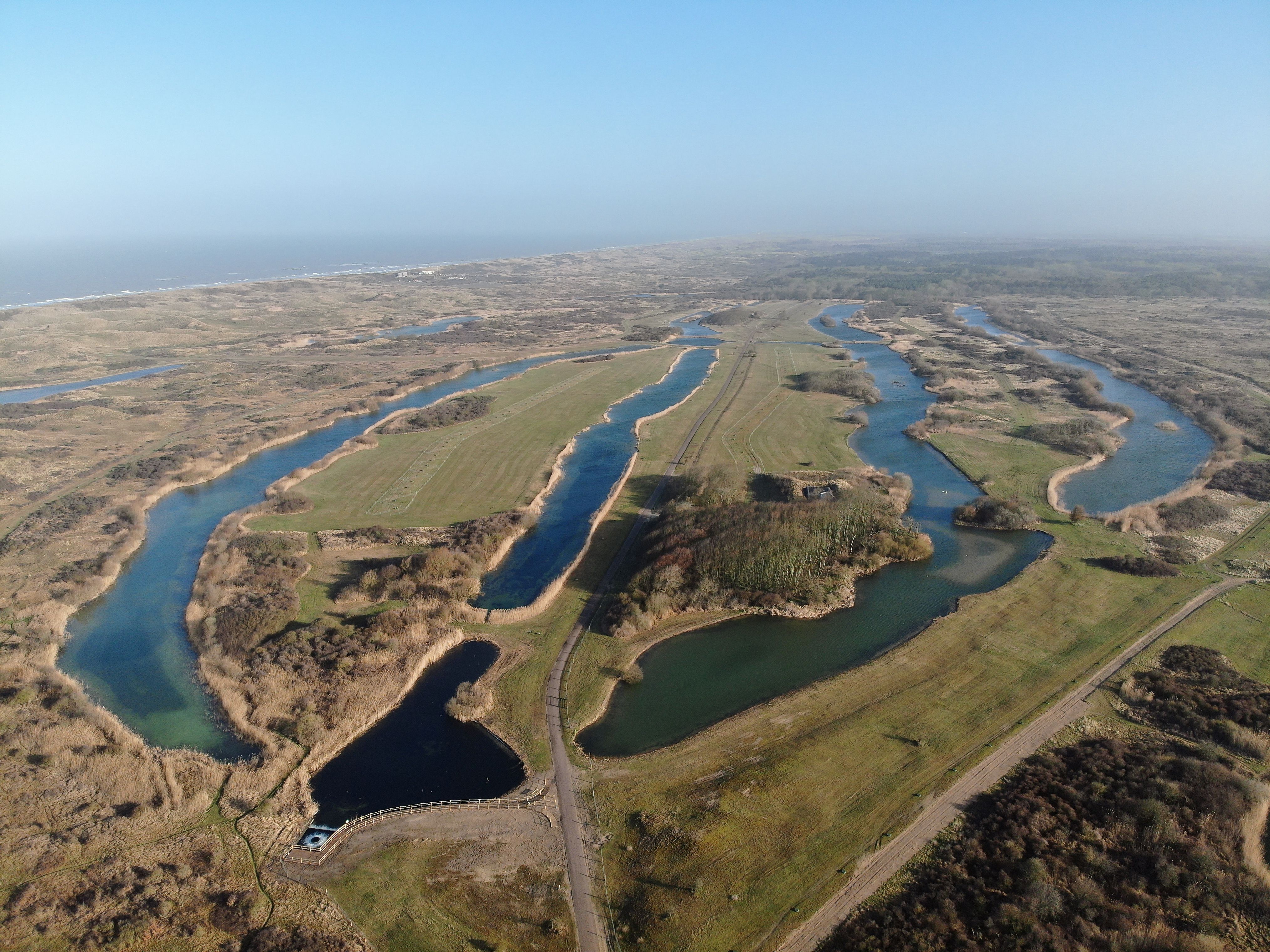
ICAS dune infiltration ponds
Source: PWN
Description
PWN supplies about 112 million cubic meters of drinking water annually to more than 800,000 households, companies and institutions in the province of North Holland. The drinking water system, developed from the 1950s onwards, uses surface water as the main water source. Part of this water is directly treated and distributed to the client, but the backbone of the drinking water supply are the dune infiltration (managed aquifer recharge, MAR) systems that are fed with pretreated surface water. After infiltration and recovery this water is distributed. The long transport pipelines from the raw water in-take points to the dunes make the system vulnerable: the failure of a pipeline has major consequences. The water quality at the intake points is also under pressure, because of salinization of the surface water during low flows of the river Rhine.
The demand for water is expected to increase in the coming decades due to population growth and increasing economic activity. At the same time, climate change is putting pressure on the supply of freshwater due to increased salinization at the intake points. The severe droughts in the past decade were clear warning signs of the challenges to be faced in the future. In response, PWN wants to transform its current water system to a more robust and resilient system. Key components in the foreseen water transition in North Holland are the use of alternative water resources, e.g. by incorporating brackish groundwater desalination, treated wastewater effluent reuse, and the creation of additional storage capacity. The question is how, where and when to add these different new components to the current (drinking) water system and how they will increase its capacity and robustness.
This case study focuses on the PWN drinking water system north of the Noordzeekanaal (the east-west stream in Figure 3, but also includes the connected supply and demand areas south of this canal.
Applied technologies
Technology performance and best practices
Currently, PWN operates a well-functioning drinking water system, as the drinking water demand can be met year-round. However, initial modeling results, to be included in D1.4, show that climate change and increasing demand will put the drinking water system under pressure. PWN has already planned some measures to secure the water supply for the upcoming years, including nearly doubling the RO-treatment capacity and regenerating the clogged infiltration wells of the DWAT dune infiltration system. However, to be able to withstand the challenges from 2035 onwards, PWN is exploring the implementation of alternative water resources (AWR).
Outcome of assessments
Based on a system dynamics model of the PWN drinking water system, the potential impact of AWR on the system performance was assessed based on different demand scenarios and the SSP5-8.5 climate scenario for 2035, 2050 and 2100. The following AWR were included:
- Andijk Climate Buffer: additional basin for storing water from the IJsselmeer.
- ASTR storage and treatment Overveen: current back-up groundwater source turned into well infiltration storage and treatment of treated surface water.
- ASR for drinking water storage at Hoorn and Texel: well infiltration of drinking water for storage.
- Brackish groundwater abstraction from Haarlemmermeer.
- WWTP effluent use: treatment of treated wastewater from the plants at Beverwijk and Wervershoof as a source of drinking water.
The first model results, to be published in D1.4, showed that combined use of AWR resources alleviates the stress that climate change and demand increase pose on the drinking water system.
Due to climate change, more extensive periods of drought and therefore periods of salinization of the IJsselmeer will occur, causing prolonged intake stops of water from the IJsselmeer. The effect of these intake stops propagates through the system, using the buffer capacity from the surface water reservoirs at Andijk and the dune infiltration systems. Several AWR solutions, e.g. the climate buffer, ASR and ASTR, provide additional buffering capacity, extending the period without intake from the IJsselmeer the system can provide in the drinking water demand.
Increase in the drinking water demand, due to population growth and increased economic activity, put more structural pressure on the drinking water systems, and AWR solutions are needed to create additional sources of drinking water within the system, in this CS brackish water extraction or the reuse of WWTP effluent. These AWR require additional treatment, which make these kind of AWR generally more extensive and energy-intensive than buffering solutions. Additionally, residual flows are produced in the treatment process, causing environmental risk and therefore legal complexity. Moreover, when AWR sources are used to increase the total production capacity, the modelling results indicated that treatment and transport capacity within the system should also be expanded in line with the AWR implementation to maximize the added value of AWR.
Legislation and policy recommendations
In response to recent droughts (2018–2020, 2022), the Netherlands has increased efforts to promote water savings and explore the integration of AWR in water supply systems. However, concrete policy goals and enforceable standards for water reuse and circular water management remain underdeveloped. Stakeholders (utilities, indsutries) acknowledged the urgency to act but pointed to a lack of regulatory clarity and legal certainty.
At the national level, the Drinking Water Act grants licensed utilities exclusive rights to produce and distribute drinking water (see Figure 6). While it does not prohibit the use of alternative sources (e.g., reclaimed or brackish water), the absence of standardized quality criteria complicates implementation. However, standardized quality criteria do exist for the use of surface water as a drinking water resource, embedded within the Drinking Water Regulation. The creation of similar criteria for other sources, such as reclaimed water, is currently being explored. Similarly, under the Environmental Management Act, treated effluent is still classified as waste, though its “useful use” is permitted under specific conditions. This creates legal and administrative uncertainty for reuse initiatives, especially when navigating the Market and Government Act.
Publications and references
W. Gernjak, A. Daaboub, N. Klamerth, Á. Bosch, A. Pedregal Montes, R. Mercado Bettin, E. Hernández Busto, Q. Plana Puig, A. Kleyböcker (2025). Future water supply availability and demand based on different RCP scenarios. D1.1 RECREATE, ICRA, Girona, Spain, 84 p.
A. Kleyböcker, I. Suárez Aguirre, L., Girier-Dufournier, K., Raat, L., Brokx, H., Milter, P. Thisgaard, I. Zarikos, N. Klamerth, A. Cremer, K. Baumann: Report on identified drivers, barriers and future risks on implementation of AWR, D1.2 RECREATE (GA No 101136598) Kompetenzzentrum Wasser Berlin gGmbH, Berlin, Germany, 2024.